
Dairy Pastures
Climate change is likely to offer both opportunities and challenges for dairy pastures in NSW by 2050.
Dairying forms a significant agricultural activity in NSW which grows a variety of pasture species that underpin the feedbase for dairy cows. The dairy industry is spread widely across different climates in NSW, from the subtropical climate of Lismore to the semi-arid conditions of the Riverina, with most dairy farms located on the mid-north and far south coasts. As of 2025, there were a total of 443 licenced dairy farms in NSW, with an average milking herd size of 343 cows. The map shows the number of dairy cows in NSW (by LLS region), with darker colours representing higher numbers.

Six key pasture species were chosen for the Climate Vulnerability Assessment: kikuyu, ryegrass, white clover, lucerne, forage oats and chicory. These species were selected based on their relevance to the dairy industry in the areas across the state where they are found. It is important to note that other forage species play a role in the dairy industry but are not as significant as these 6, due to different factors such as lack of persistence or feed quality or not yet being in widespread use.
What is the NSW DPIRD Climate Vulnerability Assessment? ⏷
Climate change is altering the growing conditions for many agricultural commodities across NSW. Primary producers need evidence-based information about the changing climate, and the risks and opportunities it may bring.
The NSW DPIRD Climate Vulnerability Assessments are enhancing the resilience of our primary industries by providing information and data to help the sector better plan for, and respond to, climate change. They have assessed climate change impacts for extensive livestock, broadacre and irrigated cropping, marine fisheries, forestry, horticulture and viticulture, and important biosecurity risks associated with these industries to inform sound planning, risk management and adaptation decisions.
How we assessed climate suitability ⏷
Climate projections were sourced from Climate Change in Australia’s ‘Application Ready Data’. This dataset is comprised of projections from an ensemble of 8 global climate models, each presenting a plausible future climate. The models differ in their projections, giving rise to uncertainty which is reflected in the confidence statements given in brackets. Care should be taken when interpreting these results.
The Climate Vulnerability Assessment is intended to highlight potential industry- or regional-level changes. Intermediate and high emissions scenarios were used in the assessments (RCP4.5 and RCP8.5), but these are not the only future scenarios possible. The inclusion of climate variables important to the commodities production was based on published research, expert knowledge and data quality and availability.
Learn more in the Climate Vulnerability Assessment Project Framework.
Climate impacts: what to expect
Climate suitability for dairy pastures varies between pasture species and time of the year across all NSW dairy regions.
Hunter dairy region
Autumn
- Minimal to moderate decreases in climate suitability are expected for forage oats, lucerne, ryegrass and white clover in early to mid-autumn across the Hunter dairy region.
Winter
- Minimal to moderate increases in climate suitability are likely to occur for lucerne and ryegrass during winter around Muswellbrook and Tamworth.
- Minimal decreases in climate suitability are expected for white clover across the Hunter dairy region.
Spring
- Minimal to moderate decreases in climate suitability are likely for forage oats, lucerne, ryegrass, and white clover during spring across the Hunter dairy region.
Summer
- Minimal to moderate decreases in climate suitability are likely for chicory, forage oat, lucerne and white clover during summer across the Hunter dairy region.
Inland dairy region
Autumn
- Minimal to moderate decreases in climate suitability for forage oats, lucerne, ryegrass and white clover are likely to occur in early to mid-autumn across the Inland dairy region.
- Minimal increases in climate suitability for ryegrass near Cowra and Forbes is likely to occur in mid-autumn.
Winter
- Minimal to moderate increases in climate suitability for lucerne and ryegrass are likely to occur in winter across the Inland dairy region, with similar increases around Cowra for chicory.
Spring
- Minimal increases in climate suitability for kikuyu are likely to occur in spring around Cowra.
- Minimal to moderate decreases in climate suitability for forage oats, lucerne, ryegrass and white clover are likely to occur in spring across the Inland dairy region.
Summer
- Minimal to moderate decreases in climate suitability are likely to occur for chicory and lucerne across the Inland dairy region during summer, and for forage oats and ryegrass around Cowra.
- Minimal increases in climate suitability is likely to occur for kikuyu near Dubbo in late summer.
Riverina Murray dairy region
Autumn
- A minimal increase in climate suitability is likely to occur for ryegrass in mid-autumn near Deniliquin.
- Minimal to moderate decreases in climate suitability are expected for forage oats, lucerne and ryegrass across the region in early to mid autumn.
Winter
- Minimal increases in climate suitability are likely to occur for lucerne and ryegrass across the region during winter.
- Minimal increases in climate suitability for chicory is also expected near Wagga Wagga.
Spring
- Minimal to moderate decreases in climate suitability are expected for forage oats, lucerne and ryegrass in late spring across the region and for white clover throughout the spring months around Finley and Wagga Wagga.
Summer
- Minimal to moderate decreases in climate suitability are expected for forage oats and ryegrass in late summer, and for lucerne throughout summer, across region.
- Minimal decreases in climate suitability for chicory is expected near Wagga Wagga in early to mid summer.
South Coast dairy region
Autumn
- Minimal to moderate increases in climate suitability are likely in autumn for kikuyu across the region in autumn, and a minimal increase in climate suitability for chicory near Bodalla.
- Minimal to moderate decreases in climate suitability are likely for forage oats, lucerne, ryegrass and white clover during autumn months across the region.
Winter
- Minimal to moderate increases in climate suitability are likely for chicory, lucerne, forage oats, kikuyu and ryegrass during some winter months across the region.
- Minimal to moderate increases in climate suitability for chicory near Bega, for kikuyu near Bodalla and for forage oats near Nowra in mid-winter.
Spring
- Minimal increases in climate suitability are likely for kikuyu across the region from early to mid-spring.
- Minimal increases in climate suitability for ryegrass is likely near Nowra in mid spring.
- Minimal to moderate decreases in climate suitability are expected to occur for forage oats, lucerne, ryegrass and white clover during near Nowra during late spring.
Summer
- Minimal to moderate decreases in climate suitability are likely for forage oats, ryegrass and white clover across the region throughout summer.
North Coast dairy region
Autumn
- Minimal increases in climate suitability are likely to occur for kikuyu during mid to late autumn around Kempsey and Taree.
- Minimal to moderate decreases in climate suitability are expected forage oats, ryegrass and white clover across the autumn months across the North Coast dairy region.
Winter
- Minimal increases in climate suitability are likely to occur for chicory and kikuyu during the winter months across the North Coast dairy region, and for forage oats near Taree.
- A minimal decrease in climate suitability for white clover is expected near Lismore in late winter.
Spring
- Minimal to moderate decreases in climate suitability are likely to occur for chicory, forage oats, lucerne, ryegrass and white clover during the spring months across the North Coast dairy region.
Summer
- Minimal to moderate decreases in climate suitability are likely to occur for chicory, forage oats, lucerne, and white clover during the summer months across the North Coast dairy region.
Adapting to the changing climate
As climate change alters the timing of pasture growth, dairy farmers can continue to build on existing management practices to maintain the volume and quality of feed. These can include:
- Selection of pasture species suited to future seasonal patterns.
- Adjust sowing times to match changes in autumn and spring to improve establishment.
- Align calving and lactation with peak pasture availability, as spring growth may be shorter and autumn growth delayed.
- Increase the use of conserved fodder to help buffer feed supply during months of reduced pasture growth.
Where can I find the climate suitability maps?
Maps of historical and future climate suitability for commodities were produced to demonstrate where in the state a commodity is likely to thrive or else be limited by future climatic conditions. The maps are provided in the Dairy Pastures Results Report (PDF, 7630.37 KB) and its accompanying Appendix (PDF, 12276.28 KB).
Data availability
The geospatial data which was used to prepare the Dairy Cow Results Report are available on SEED, the NSW Government’s environmental data portal, in the Climate Vulnerability Assessment collection.
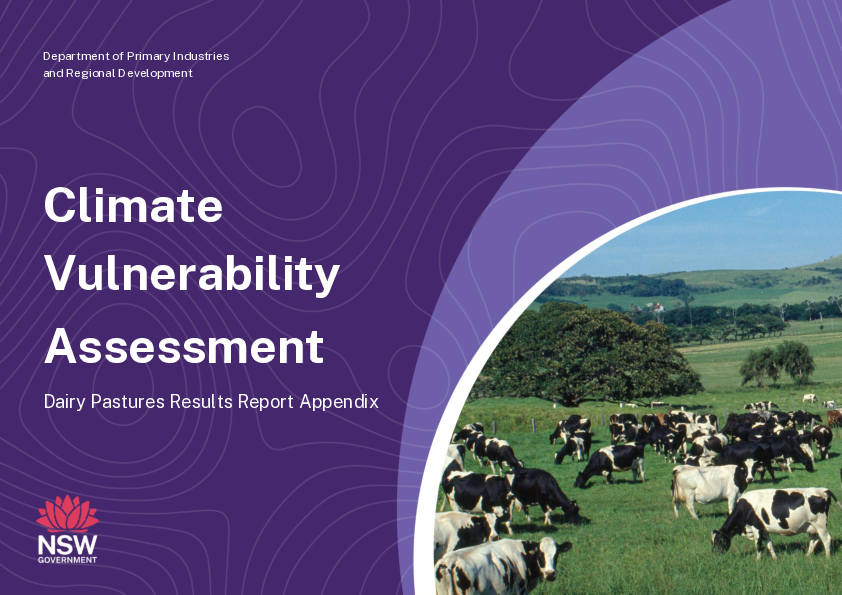
Dairy Pastures Results Report
(PDF, 7630.37 KB)

Dairy Pastures Results Report Appendix
(PDF, 12276.28 KB)
Funding
The Storm and Flood Recovery Program – Dairy Sector Recovery and Resilience project was funded by the Australian and NSW Governments' Storm and Flood Recovery Program.
Contact us
For more information, please get in touch with vulnerability.assessment@dpird.nsw.gov.au