

Fruit tree borer
The fruit tree borer is the larval stage of Maroga melanostigma, an Australian native moth that will affect a wide range of tree species; Prunus (stone fruit) are particularly susceptible.
Pest identification
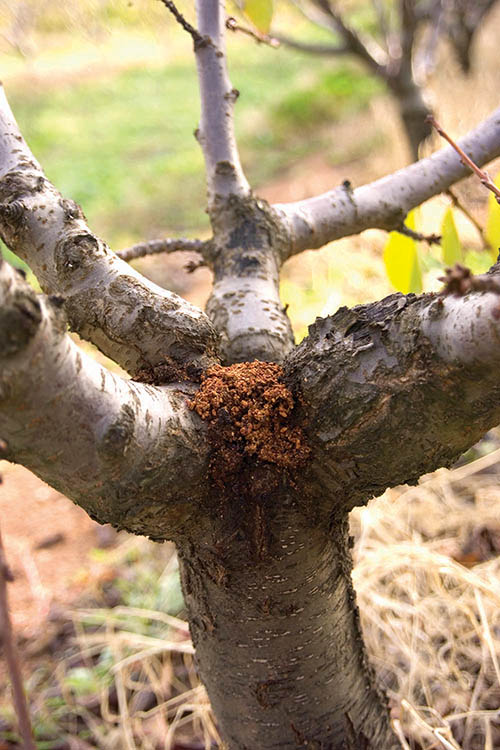
Usually, the first sign of fruit tree borers will be webbed sawdust material on scaffold branches or on the trunk where major branches intersect. Adult moths are cream–white with a black and orange abdomen, about 20 to 25 mm long, with a wingspan of about 40 mm. The forewings each have one small black dot. The larvae are cream with a dark head.
Damage
Fruit tree borers damage stone fruit trees when the larvae (caterpillars) chew the bark and tunnel into the stem or trunk. This damage often results in a complete ring-barking of the branch or trunk. When severe, it can lead to tree decline and eventual death. In young trees, the damage can cause the loss of a leader branch, affecting tree training and shape.
Monitoring
Inspect structural limbs and tree trunks for telltale sawdust patches.
Management
Cultural and physical: physical management is labour-intensive as it involves scraping away the sawdust and destroying the larvae found under the bark or in its tunnel. A fine wire can be used to penetrate the feeding tunnel and kill the larvae.
Biological: Trichogramma species wasps will parasitise fruit tree borer eggs; however, it is uncertain if this will provide commercial-level control.
Chemical: check the APVMA PubCRIS database for registered controls (https://portal.apvma.gov.au/pubcris).
