
Grapevine leaf rust
Phakopsora euvitis is an exotic plant pest causing grapevine leaf rust. This disease is a serious threat to Australia’s viticulture industry.
Grapevine leaf rust was detected in 2001 in Darwin, Northern Territory. An eradication program was conducted between 2003 and 2007. On 1 July 2007 the Northern Territory was declared free of grapevine leaf rust.
Notifiable status
Grapevine leaf rust is a notifiable plant disease in NSW.
All notifiable plant pests and diseases must be reported within 1 working day. You can report notifiable plant pests and diseases by one of the following methods:
- Call the Exotic Plant Pest Hotline 1800 084 881
- Email quarantine@dpird.nsw.gov.au with a clear photo and your contact details
- Complete an online form
A full list of notifiable plant pests and diseases can be found in Schedule 2 of the NSW Biosecurity Act 2015.
Symptoms
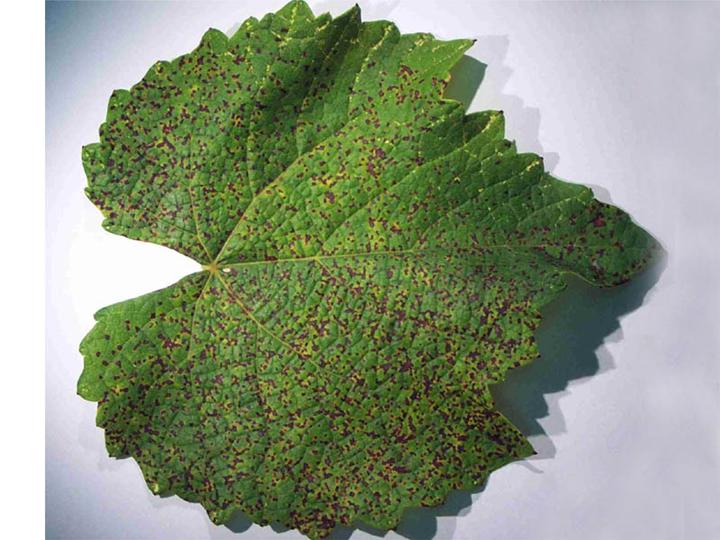
Grapevine leaf rust appears as angular brown spots on the topside of the leaf. The affected leaf tissue dies (Figure 1).
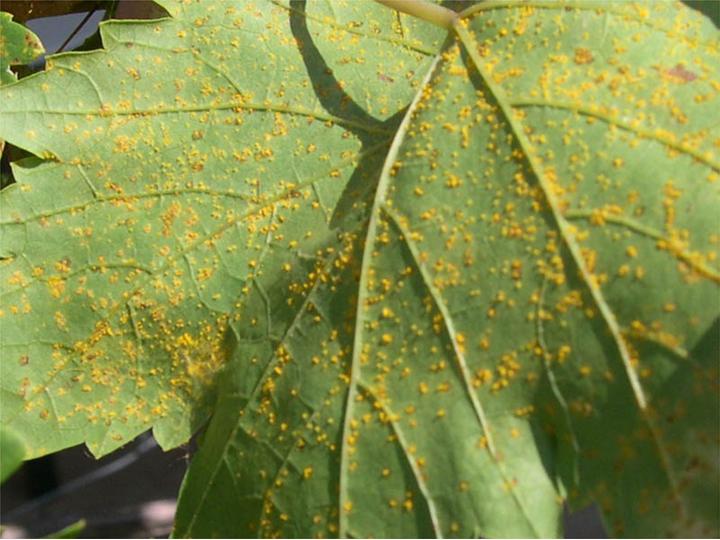
On the underside of the leaf the spots correspond to a yellow-orange mass of powdery spores (Figure 2).
Infection of leaves by grapevine leaf rust can be found throughout the canopy.
Damage
Grapevine leaf rust can cause premature defoliation of the grapevine during the growing season. This results in poor shoot growth and a reduction in the quantity and quality of the fruit.
Disease cycle
Grapevine leaf rust can infect vines all year round but is most noticeable in northern Australia during the dry season.
Hosts
Grapevine leaf rust only appears on the leaves of cultivated grapevines and two closely related plant species which are native to northern Australia (Ampelocissus acetosa known as wild grape and A. frutescens known as native grape).
Distribution
Grapevine leaf rust is endemic and widely spread throughout South East Asia.
Grapevine leaf rust has spread to Central America.
Spread
Spores of Phakopsora euvitis can be transported by wind and air currents.
People travelling to South East Asia, particularly Bali or East Timor, should be aware that fungal spores such as grapevine leaf rust can adhere to clothing and other possessions.
Should you visit overseas areas where grapevines are present, wash your clothes before you go anywhere near grapevines back in Australia.
Actions to minimise risks
Put in place biosecurity best practice actions to prevent entry, establishment and spread of pests and diseases:
- practice “Come clean, Go clean”
- ensure all staff and visitors are instructed in and adhere to your business management hygiene requirements
- source propagation material of a known high health status from reputable suppliers
- monitor your vineyard regularly
- keep records