July 2026
NSW summary
Overview
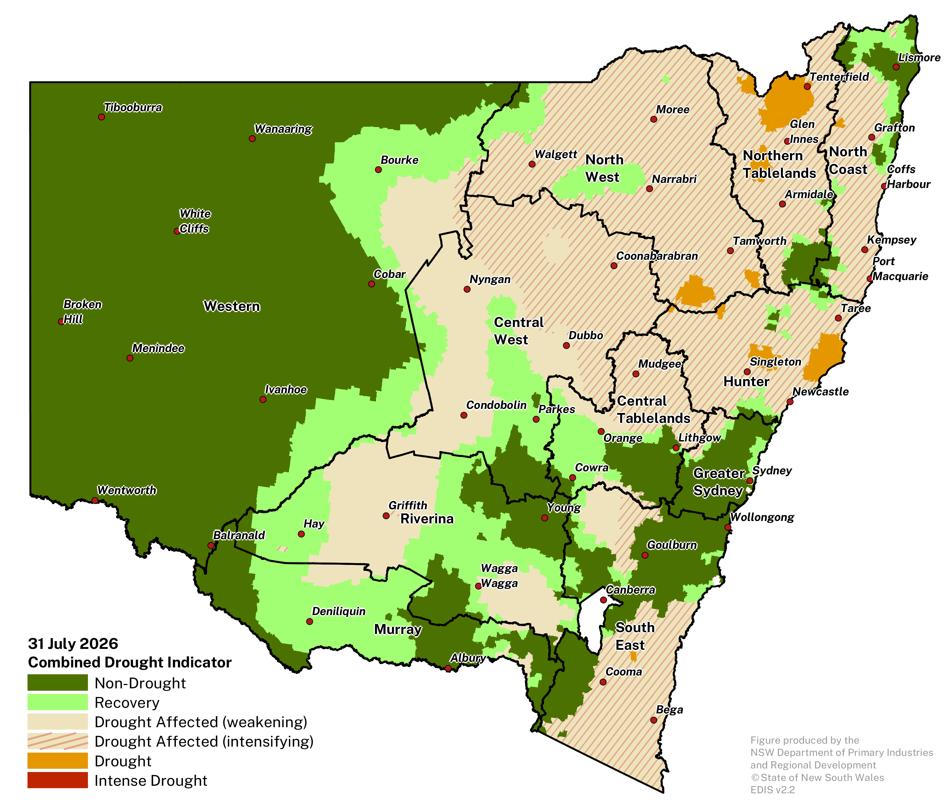
Rainfall variability continues to create contrasting seasonal conditions in NSW, with strong recovery in some regions and ongoing drought impacts in others.
- On-ground conditions and production outlooks continue to improve across some regions, particularly in parts of the Central Tablelands, Riverina and Murray. However, recovery has slowed elsewhere, including parts of the southeast, where rainfall has not been sufficient to maintain earlier improvements.
- Longer-term rainfall deficits continue to affect drought-affected areas of northern NSW. In these regions, producers remain focused on implementing drought management strategies particularly for livestock management, supplementary feeding and farm water supply.
- Above median temperatures across much of NSW in June and July have supported late-season pasture response. However, this growth may not reflect underlying soil moisture deficits and may represent a “green drought” in some areas.
- Winter crops continue to require follow-up rainfall to maintain yield potential. Cooler temperatures and frost events have also been observed during July, although their impact on production is still being assessed by producers.
- Ongoing variability in local conditions and the seasonal outlook will continue to influence producer planning and decisions over the coming months.
- Current forecasts suggest a higher likelihood of drier conditions, increasing the risk of seasonal variability. However, producers in areas where conditions have recently improved may be able to capitalise on opportunities if recovery is sustained.
- The Bureau of Meteorology’s seasonal outlook issued on 6 August indicates an increased likelihood of below median rainfall for parts of southern, central and coastal regons, with warmer conditions for spring across NSW.
- The NSW DPIRD Drought Forecast to 31 October 2026 is that drought conditions will persist across parts of NSW, with a decline and intensification of conditions likely for some regions.
More detail is available for each LLS region in the regional breakdown section of this Update.
Climate and drought Outlook
The most likely outcome is for drought conditions to persist across much of NSW.
- The Bureau of Meteorology’s climate outlook highlights low to neutral chances (20-55% chance) of rainfall being above the median for the three-month period to 30 November 2026.
- DPIRD’s Drought Forecast is that the most likely outcome is for drought conditions to persist across much of central and eastern NSW at the end of October. The percentage of NSW most likely to be in any drought category of the NSW-CDI at the end of the forecast period is 51% (with an uncertainty range of 33-61%). More information can be found in the DPIRD Drought Forecast section.
- At a regional level drought conditions will likely intensify across parts of northern tablelands, Hunter and northern NSW.
Status of Climate Drivers
- The Indian Ocean Dipole value is currently +0.63oC, and the ENSO Relative Niño 3.4 value is +2.02oC (as of 2 August 2026). The Southern Oscillation Index is currently -29.2 (as of 1 August 2026).
- El Niño has been underway since mid-June and continues to strengthen, with further intensification likely in the coming months. Models also suggest a positive IOD may develop during the southern hemisphere winter and persist into spring, although there remains some variation in timing and strength of this potential event.
- The positive phase of ENSO (i.e., El Niño) and positive IOD events are often associated with hotter, drier conditions across eastern Australia. However, the strength of either event doesn't always match the strength of its impact in Australia. A weaker event can have major effects, while a stronger one may not.
- It is important to continue to monitor ocean and atmospheric conditions, along with rainfall and temperature outlooks over the coming months.
More information can be found in the Seasonal Outlook and Drought Forecast sections.